He spent AED 400,000 on his café. A buyer will pay for almost none of it.
9 September 2026BizBuy
A coffee shop, a proud owner, and a painful number
Last week I met the owner of a café in Jumeirah Village Circle. He’s selling, and his asking price was AED 400,000. Fair enough — until I asked about the numbers.
Revenue last year: about AED 800,000. Solid for a small café. Profit? Around AED 5,000 for the entire year — barely a rounding error.
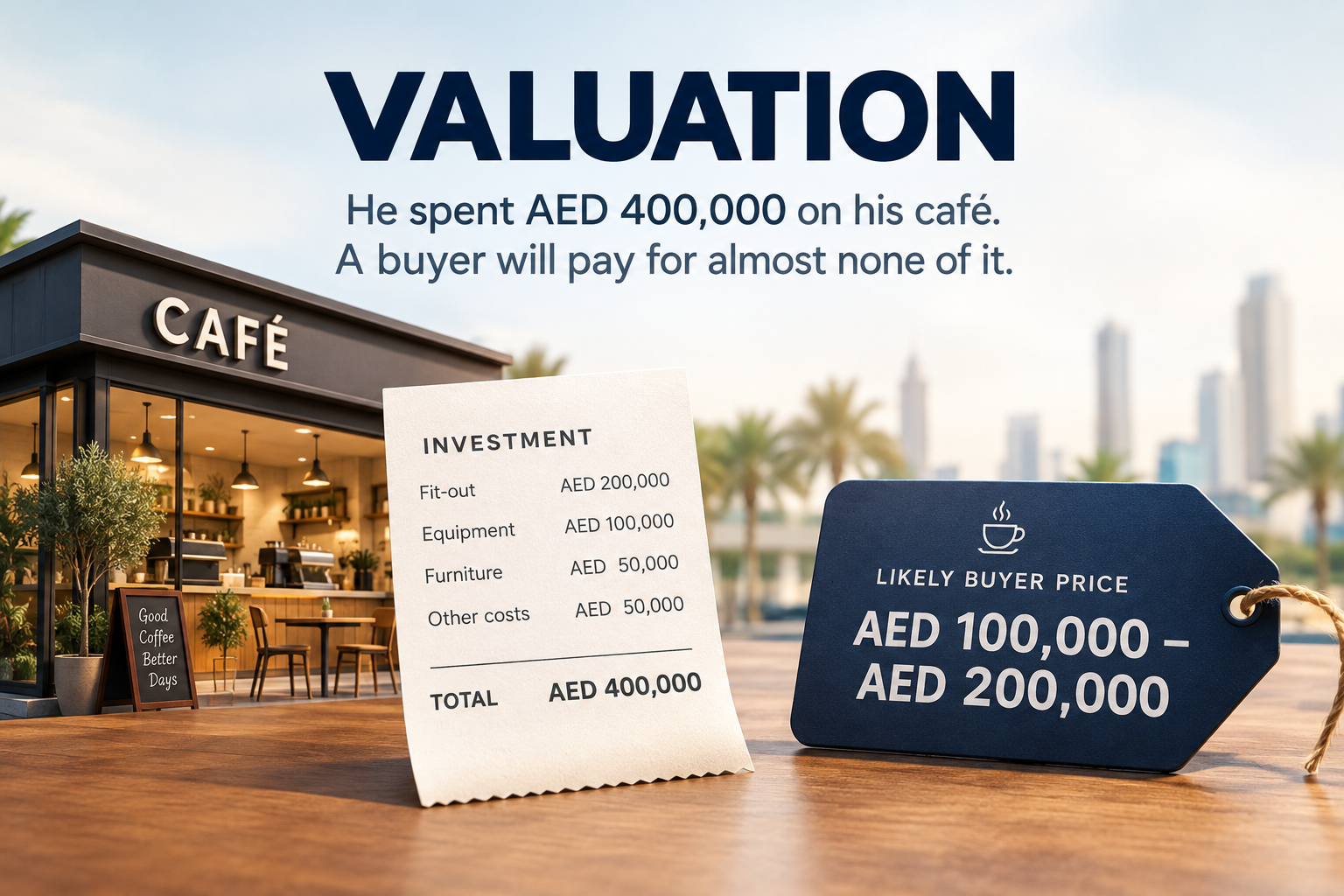
Then he told me the part he was proudest of: he’d invested AED 400,000 building the place — the fit-out, the machine, the furniture, every detail chosen by hand. He wanted to sell for 400K to get his money back. I understood completely. And I had to tell him something no seller wants to hear.
Buyers don’t pay for what you spent. They pay for what they’ll get.
Here’s the hard truth of every business sale: the money you put in is your story — it is not the buyer’s price. A buyer isn’t purchasing your effort, your late nights, or your AED 400,000 of receipts. They’re buying a future: the cash flow the business will put in their pocket, and what similar businesses actually change hands for. Your investment is a sunk cost. To the market, it’s invisible.
The car with the hand-stitched leather
Imagine you’re selling a used car. You tell the buyer you flew to Tanzania for the finest leather, carried it back to Italy yourself, and had master artisans redo the entire interior by hand. Beautiful. Genuinely. The buyer nods… and then prices the car the way every used car is priced: year, model, mileage, engine condition. Your leather story doesn’t move the number. Neither does a fit-out.
So what is a “ready” café with AED 800,000 revenue and almost no profit actually worth?
The honest answer is: it depends. So let’s do it properly, the same four ways a buyer — or our free valuation — would.
On profit, it’s worth almost nothing. Earnings-based value capitalises the profit, and AED 5,000 a year capitalised is worth maybe AED 15,000. This is the lens that stings, and the one that matters most.
On revenue, it’s a trap. AED 800,000 in sales sounds like it deserves a healthy multiple — but a revenue multiple quietly assumes the business makes a normal margin. This one doesn’t. Paying a full revenue multiple for a business that barely breaks even is exactly how buyers lose money, and smart buyers know it.
On assets, it’s resale value, not receipts. The equipment and fit-out are worth something — but their second-hand value, not the AED 400,000 spent. A used espresso machine and fridges hold some worth; bespoke joinery holds very little. Tens of thousands, not hundreds.
On being “ready”, you find the real prize. A buyer gets a licensed, fitted, operating location with customers already walking in, and skips three to six months of setup, licensing and build-out risk. That turnkey premium is worth paying for.
Add it up — modest asset value plus a turnkey premium, then discounted hard because there’s almost no profit and therefore real risk — and a ready café like this is realistically worth somewhere between AED 100,000 and AED 200,000. Not 400,000. And painfully, not the 400,000 he put in.
Why this is good news, not bad
If you’re a seller, this isn’t a reason to despair — it’s a map. The gap between “asset value” and a real, attractive price is one thing: profit. The day this café shows even a modest, believable profit, it stops being an asset sale and becomes a business — and businesses sell for multiples of earnings, not scraps of fit-out value. A buyer who can see a clear path to profit will pay for that path.
So before you list: get to profit, even a small one, and show it clearly. If an owner’s salary or one-off costs are hiding the profit, document those add-backs — that’s real value most sellers leave on the table. And price on what the business is, not what you spent. A realistic price sells in weeks; a hopeful one sits unsold for a year while the lease burns.
The number you spent is behind you. The number a buyer pays is in front of you.
The café owner in JVC didn’t do anything wrong by investing in his place. He just measured its worth with the wrong ruler. Once he prices it for what it is — a ready, revenue-generating location a buyer can turn around — he’ll actually sell it.
Curious what your business is really worth? BizBuy’s free, confidential valuation values it four ways — profit, SDE, EBITDA and assets — in about two minutes, no listing required. Find it under “Value my business” on bizbuy.ae.
Thinking of selling — or looking to buy?